Mailing books, catalogues and flat items without tape
How to pack books, catalogues, documents, discs and folded clothes without tape, using cohesive paper or corrugated: sheet size, overlap and corners.
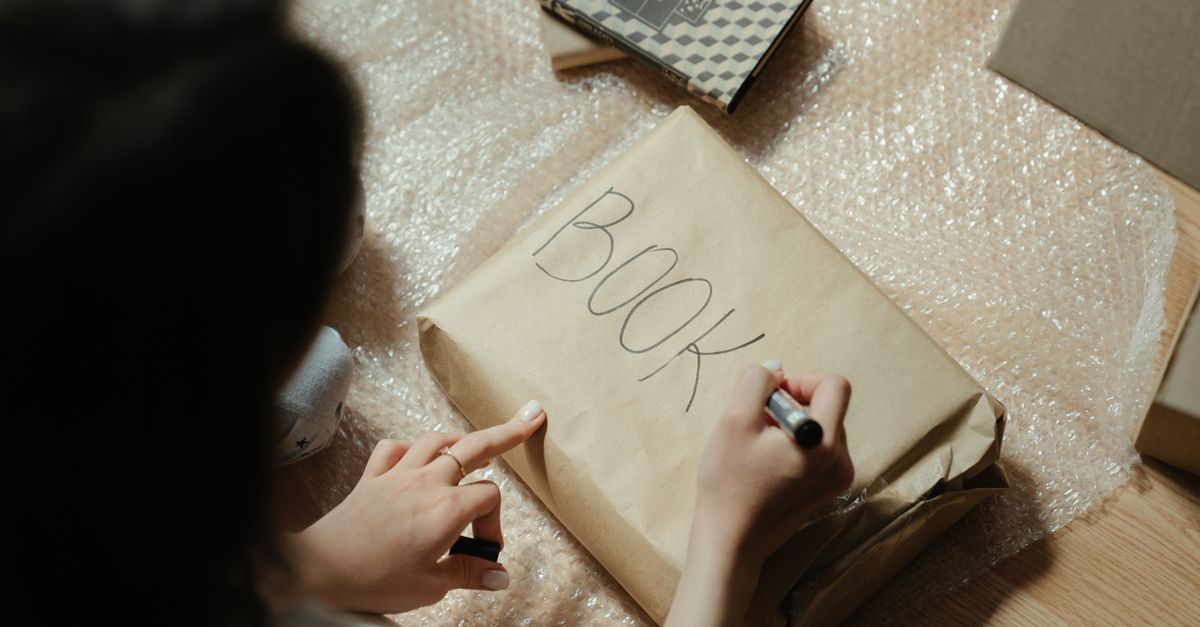
Many of us covered our school books in brown paper at the start of every school year. It was a family job. One person cut the paper, another folded the corners, and somebody always ran out of tape halfway through the stack.
Packing books for courier is the same job at a bigger scale.
Tape is still the slow part.
Here is the short answer. To mail a book or catalogue without tape, wrap it in cohesive (self-seal) paper or cohesive corrugated, and press the coated faces together. Paper is the inner wrap: it keeps dust and scuffs off, and the book then goes into a mailer or box. Corrugated can be the whole pack, because it stiffens the item and pads the corners. Both seal with hand pressure alone.
Checked against sources on 29 October 2026.
We make self-seal paper in Jaipur. We coat the kraft paper with a natural rubber latex cohesive on our own coating line, so we have a view on this. I have tried to show, item by item, where paper alone is not enough.
Three rules for every flat item
- Coated face in. Lay the item on the coated side, in the centre, fold the sheet over and press. Hisago, a Japanese maker, gives the same three steps on its product page: place the item, overlap the coated faces, press firmly around the edges by hand.
- Leave enough seal. Hisago suggests pressing at least about 25 mm all around the contents, so they cannot slip out. I use 25 mm as the minimum in every size below.
- Press with the flat of your hand along every seal. The coat needs pressure, not heat. A quick touch with the fingertips leaves weak spots.
Most mailers close with their own peel-and-seal strip. So with a cohesive wrap inside, the whole parcel can go out with no tape at all.
How big should the sheet be?
Our product page says to measure the item's girth, add overlap for the coated edges, and pick a width that covers the item's length. In numbers:
- Cut length = girth + 25 mm. Girth is the distance all the way round, i.e. 2 x (width + thickness).
- Roll width = item length + 2 x (half the thickness + 25 mm). Each end needs enough paper to cover half the thickness, plus a 25 mm seal.
Here is a worked example with a standard A5 paperback, 148 x 210 mm and 20 mm thick:
- Cut length: 2 x (148 + 20) + 25 = 361 mm.
- Roll width: 210 + 2 x (10 + 25) = 280 mm. A 300 mm roll fits, with a little to spare.
Now turn the same book, so the short side runs across the roll. The width it needs drops to 148 + 70 = 218 mm, and a 10 inch (254 mm) roll works. The cut length grows to 2 x (210 + 20) + 25 = 485 mm.
This is worth knowing, because one roll width can then cover two book sizes.
I would measure your three most common titles before you order any rolls, not after.
An A4 catalogue 5 mm thick works the same way. Turned so the 210 mm side runs across, it needs 210 + 2 x (2.5 + 25) = 265 mm. That is a 300 mm roll again, cut to about 630 mm.
Both widths in these examples are standard sizes. We slit our paper on a 3-inch (76 mm) core to the European 300 and 600 mm x 200 m rolls, and to the North American 6, 7.5, 10 and 15 inch widths on about 705 ft rolls. The details are on Jagannath Polymers' self-seal paper page.
A single book, paperback or hardback
Books are sturdy. They do not break. They arrive with scuffed covers, dented corners and, if they are paperbacks, a permanent curve. Our guide on choosing cushioning by product puts books in its sturdy group for that reason.
So the only real question is the outer pack.
- Into a mailer or box: wrap the book in cohesive paper first. The paper stops the cover rubbing on the box over a long ride, and keeps the dust off. Our guide on why products break in transit shows how vibration does that rubbing.
- With no other pack: use cohesive corrugated. A Swiss stockist, Coplax, sells self-adhesive B-flute sheets at 225 g/m² and names mail-order books among their uses. A Dutch stockist, RBI Apeldoorn, sells five sheet sizes from 23 x 33.5 cm up to 46 x 58 cm, and says no other packaging is needed.
For most single books, I would start with the first option and keep corrugated for orders that leave with no box around them.
One tip on corrugated. It bends easily one way and resists the other. Roll a sheet gently in your hands and you will feel it. Wrap the book so the easy direction goes around it and the stiff direction runs along its length. A roll is already wound that way, so a cut piece from a roll gets it right on its own. With a loose sheet, check before you wrap.
If you are not sure which of the two materials your product needs, our comparison of cohesive paper and cohesive corrugated wrap sets them side by side.
Several books, or a box set
The risk here is movement. Loose books slide against each other, and every slide rubs a cover.
- Stack them flat. If the stack leans because the spines are thicker, turn every second book round.
- Wrap the whole stack in cohesive paper as one block. It now travels as a single unit.
- Put the block in a box that fits, and fill the gaps so nothing slides. Air pillows or crumpled paper both do this job.
I would not use paper as the outer pack for a set. A stack of hardbacks gets heavy fast, and a paper wrap cannot protect corners carrying that weight. Use a strong box.
Catalogues, brochures and magazines
Catalogues have three weak points. They bend, their corners curl, and glossy covers show every scuff.
- One catalogue to one customer: a cohesive corrugated sheet, or cohesive paper with a stiff board inside. The board stops the bend.
- A bundle to a dealer: wrap the stack in paper as one block, then put it in a carton. The wrap protects the top and bottom copies, which take the rubbing.
- Glossy and laminated covers: test first. Our product page asks buyers to try a sample on very glossy surfaces before changing over.
Catalogues are a known use for this material. IPS Packaging & Automation lists business cards and catalogues, and catalogue fulfilment warehouses, on its applications page.
Damp is the other enemy.
Our paper is water-resistant, so a splash or damp air on the way is not a problem. It will not survive a soaking, though. And not every cohesive paper is even water-resistant: Hisago sells its roll as having no water resistance. In the monsoon, I would still send a catalogue bundle inside a carton or a poly mailer.
Documents, certificates and prints that must not bend
These need stiffness more than anything else.
Make a sandwich. Put the document between two boards slightly larger than it, then wrap the sandwich in cohesive paper. The paper holds the boards together, so there is no tape anywhere near the document, and the document never touches the coat.
Then hold the pack by both ends and flex it gently. If you feel it bend, the boards are too thin. Our guide to bubble wrap in a poly mailer explains this bend check in more detail.
CDs, DVDs and game cases
Plastic cases crack at the hinge and the corners when they take a knock. Paper alone does very little to prevent that. Use cohesive corrugated, which pads the corners a little and stops the case flexing.
Pregis lists books and media among the uses of its cohesive materials, and IPS names CDs, DVDs and video games.
If several discs go in one order, wrap them together as one block, the same as a book set.
Folded clothes and other soft, flat goods
This is where paper alone does the job well. Fold the item, wrap it in cohesive paper, and it stays clean and folded inside the mailer. Pregis lists apparel among the uses of its cohesive paper.
In Japan, Tamura Shoten sells pre-cut cohesive kraft sheets sized for small parcel services such as Nekopos and Click Post, and says the wrapped item can be posted as it is. I like the idea of a sheet cut to the postal size. For Indian couriers, I would still put soft goods in a mailer. A courier label and a rough sorting belt are hard on a bare paper wrap.
Mistakes I would avoid
- Too little seal. Keep at least about 25 mm pressed all around, as Hisago suggests.
- Old rolls. The coat ages. Uline lists a 6 month shelf life for its cohesive corrugated wrap, and Hisago says to use its paper within about six months of opening. Store rolls cool, dry and covered, and use the older ones first.
- A PVC cover against the coat. Hisago warns against wrapping PVC items directly. Put a plain sheet in between.
- Forgetting the packers. The coat is natural rubber latex. If anyone at your packing table has a latex allergy, give them gloves.
- Treating paper as a cushion. It is not one, and that includes our own paper. A book is fine without cushioning. A glass item sent with the book is not, so wrap that one in real cushioning.
When the customer opens the parcel, the wrap can go in with paper and cardboard recycling. That is why we call our paper 100% recyclable. It is also biodegradable, because the base is plain kraft paper.
What to do next
Take the five titles or catalogues you ship most. Measure each one, work out the cut length and roll width with the two formulas above, and see how many roll widths you really need.
Then pack ten of each the new way and put them through the drop test in our warehouse guide. Look closely at the corners as well as the covers, because that is where I expect the difference to show.
If you want to try our paper, send us your book or catalogue sizes. We will work out the width with you, the same way as above.
Questions buyers ask
How does the customer open it?
By hand. The seal tears, so no knife comes near the book. Some makers also offer tear strips or perforations on their rolls, and Pregis lists both among its options.
Will it stick to a glossy cover?
It should not, because the coat bonds only to itself. Glossy and laminated covers are still where I would test first. Wrap one copy, leave it for a few days and open it. A Japanese maker also warns against wrapping PVC items directly, so put a plain sheet between a PVC cover and the coated face.
Can I send a book in cohesive paper alone?
For a short trip with a sturdy paperback, perhaps. I would not do it on a long courier route. Paper keeps the cover clean, but it does nothing for the corners, and that is where books get hurt. Use corrugated as the whole pack, or put the paper-wrapped book in a mailer or box.